


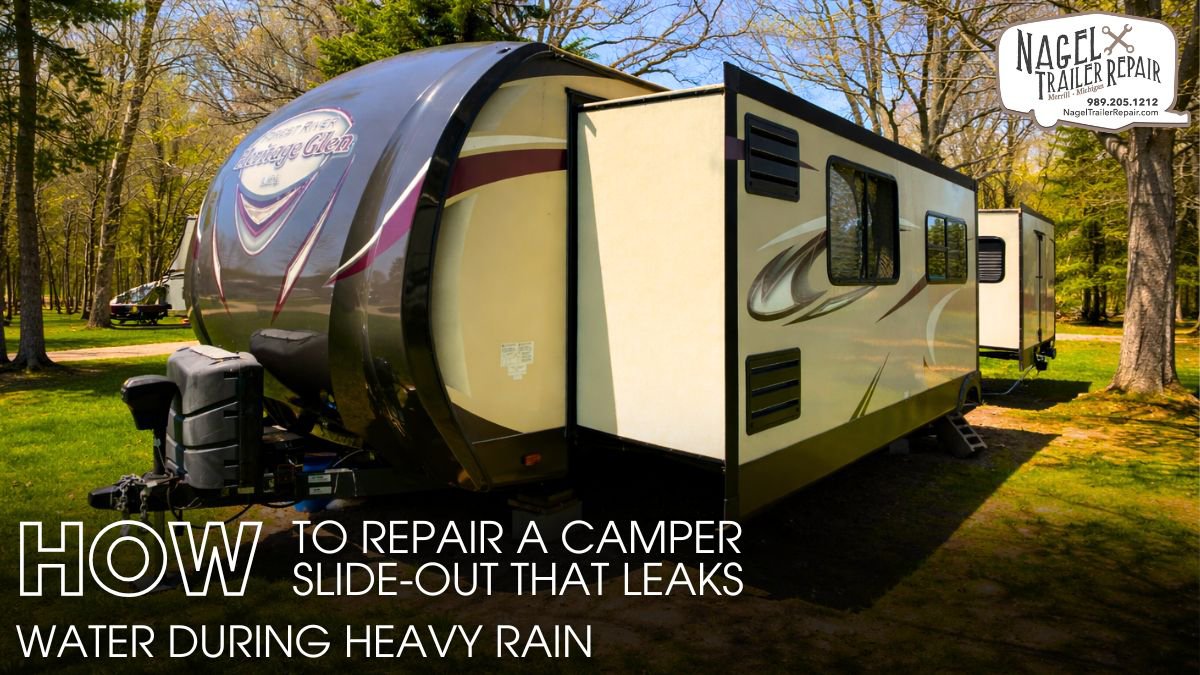
Heavy rain shouldn’t turn your camping trip into a disaster. Yet many RV owners wake up to damp cushions, stained panels, and that unmistakable musty smell creeping from the slide-out. Water always finds the smallest weakness — and it strikes fast.
Slide-out leaks rarely come from just one place. Worn seals, loose trim rails, roof seams, or poor alignment all work together to funnel rainwater inside. Most owners guess and seal randomly, only to watch the leak return during the next storm. Even a trusted camper repair shop in Michigan often sees repeat cases caused by misdiagnosis.
This guide shows you exactly how to locate the true entry point and repair it correctly the first time. You’ll learn systematic inspection, proper sealing methods, and adjustment techniques professionals use — so you stop chasing leaks and start preventing them.
Diagnose the Slide-Out Water Leak:
Most RV owners expect water to appear exactly where it enters, but slide-outs rarely behave that way. Instead, water sneaks into the smallest exterior gap, travels along framing or insulation, and finally drips somewhere completely different inside the camper. Because of that, simply sealing the visible wet spot almost never solves the underlying problem.
Start by drying the interior thoroughly. Use towels, open windows, and run fans if available. If the inside remains damp, you won’t know whether new water is entering during testing. Once everything feels completely dry, remove cushions and, if possible, interior trim near the slide opening. Even a small viewing gap helps you trace the actual water path. If you’re dealing with ongoing issues, consider searching for camper repair near me to get professional assistance.
Next, perform a controlled water test. You want to simulate gentle rain—not a pressure wash. High-pressure spraying forces water into places that normally stay sealed, leading to false results and misdirected repairs. A careful, low-pressure approach ensures you find the true entry point without causing additional damage.
Work slowly and methodically:
- Spray low side walls first
- Move upward in small sections
- Wait several minutes between areas
- Keep someone inside watching carefully
- Mark every damp spot immediately
Find the Real Slide-Out Water Leak Source:
Pay attention to timing. If water shows up after three to five minutes, it likely traveled from a higher point. For example, a floor puddle often begins at a top corner seam. For professional assistance, contact a camper repair Michigan specialist.
Also check the underside of the slide floor. Early warning signs often appear there first:
- Slight swelling at edges
- Soft wood feel
- Wrinkled vinyl flooring
- A musty smell after rain
A precise and accurate diagnosis, while requiring a bit more time and patience upfront, ultimately saves you from countless hours of frustration, wasted effort, and expensive rework down the line. In fact, a significant number of recurring leaks and persistent moisture problems happen for one simple reason: the initial investigation was incomplete or rushed.
The real, primary entry point was never correctly located, leading to temporary patches that fail as soon as the next storm hits. What you end up treating is just a secondary symptom, while the true source continues to allow water ingress.
Inspect Seals and Gaskets:
Seals are not passive components designed merely to exist in place; they are active, mechanical parts that must perform a specific job. For a seal to function correctly, it must press firmly and evenly against the mounting surface. A common misconception is that if the rubber looks intact, it is working.
In reality, a perfectly intact rubber seal will still leak if it does not compress properly against the wall or frame. This compression is what creates the watertight barrier.
This principle is especially critical for slide-out rooms on RVs. These mechanisms rely on a tight squeeze when the room is both open and retracted. When extended, the seal is compressed between the room wall and the coach body. When closed, the seal presses against the face of the slide-out. For residents in the Great Lakes State, ensuring these seals are in top condition is vital, which is why expert mobile camper repair Michigan services are often recommended for proper inspection and maintenance.
Over time, even minor wear—such as a slight flattening of the rubber profile or a misalignment of the mechanism—can significantly alter how the seal performs, creating entry points for water.
To inspect your seals properly, extend the slide-out fully and stand at an angle to view the perimeter rather than looking straight at the wall. This perspective allows you to spot light leaking through the contact points. You should see continuous, uniform contact around the entire frame.
If you notice even a thin sliver of light or a visible gap, that spot is vulnerable and you may need to search for camper repair near me. During a wind-driven storm, that small gap is all rainwater needs to be forced inside your living space.
The Physical Touch Test:
For a hands-on health check, press the rubber gently with your finger. A healthy seal will feel soft, supple, and flexible, and it will spring back to its original shape instantly when released. This elasticity is what maintains constant pressure. Conversely, aging or UV-damaged seals will feel stiff and brittle.
They may remain flattened after pressing or, worse, show small surface cracks. Once the material loses its flexibility and memory, it can no longer maintain the necessary compressive force and must be replaced.
Look closely for these common problems:
- Curled wiper seals pointing inward
- Flattened bulb seals
- Hardened rubber texture
- Uneven contact along edges
Now retract the slide and repeat the inspection. Some leaks only happen while traveling or parked closed because the interior seal becomes the main barrier.
Don’t forget the topper. A loose or torn topper lets water pool on the slide roof. Eventually, that water pushes under seams no matter how good the sealant is.
If everything looks fine but the leak continues, the alignment is likely off. Even small structural shifts can compromise good seals. That’s when it’s time to search for camper repair near me—a professional can measure compression and positioning more precisely than visual inspection allows.
Clean and Prepare The Surfaces:
Most sealing jobs fail before the sealant even touches the surface because of inadequate preparation. Dirt, oil, moisture, and old residue act as physical barriers that prevent proper bonding, causing premature failure. The time invested here determines whether your repair lasts weeks or years.
Begin by removing old sealant carefully and deliberately. Use plastic scrapers to avoid tearing or damaging the underlying roof membrane. Pull slowly and patiently rather than forcing chunks off aggressively. A smooth, clean surface bonds far better than a rough, gouged one.
After complete removal, clean thoroughly using isopropyl alcohol and clean, lint-free cloths. Continue wiping with fresh cloths until they stop picking up visible residue. Remember that invisible contamination still weakens adhesion significantly. What you cannot see will compromise your work, so be meticulous until surfaces appear pristine. This attention to detail separates temporary fixes from permanent solutions.
For professional assistance with your vehicle, consider mobile camper repair Michigan services to ensure high-quality results.
Preparation rules that matter:
- Surface must be completely dry
- Avoid sealing in direct sun heat
- Work in mild temperatures
- Keep dust away during prep
Preparation for a Lasting Seal:
To ensure a clean, professional-looking seal, begin by carefully masking off the repair area with high-quality painter’s tape. Place the tape on both sides of the seam or joint you plan to seal, creating a crisp boundary. This simple but crucial step serves two important purposes: it forces you to apply a consistent, uniform bead of sealant, and it prevents the material from being wiped too thin at the edges.
A consistent thickness throughout the application is vital, as it allows the sealant to maintain its structural integrity and flex appropriately with the natural expansion, contraction, and movement of the camper as it travels down the road.
Before applying any new sealant at a camper repair shop in Michigan, a thorough inspection of all screws along the trim rails is mandatory. Loose screws are a primary culprit in sealant failure; even the slightest gap allows for micro-movement between components, which will eventually stretch and break the bond of your fresh sealant.
Carefully check each one for tightness, but use a gentle touch when tightening. Overtightening can strip the screw’s grip in the wood, chewing out the hole and creating a larger, more problematic void that is difficult to fill properly.
Ultimately, investing time in this meticulous preparation transforms the task from a quick, temporary patch into a durable, long-term solution that will protect your camper from the elements for years to come.
Apply Sealant and Repairs:
Proper material selection stands as the most critical factor determining the long-term success of any sealing project, as different architectural surfaces and joint orientations present unique physical demands that must be addressed with specialized formulations.
For horizontal applications such as expansion joints in concrete slabs, driveways, or flat roofing membranes, self-leveling sealants represent the optimal choice due to their thin viscosity and gravity-assisted flow characteristics that enable the material to seek its own level, effortlessly filling hairline cracks and irregular gaps without requiring manual tooling or manipulation.
Conversely, vertical seams and overhead applications, such as those often encountered in mobile camper repair Michigan services, demand the distinct rheological properties of non-sag or gun-grade sealants, which possess sufficient body and internal strength to resist gravitational pull, maintaining their applied shape without slumping, drooping, or dripping during the curing process.
When installers disregard these fundamental differences and apply a single sealant type universally across a structure, they inevitably encounter premature adhesive or cohesive failures, manifested as unsightly cracking along the bond line and recurring leaks that compromise structural integrity.
The application technique itself proves equally consequential, requiring deliberate pacing and uninterrupted motion throughout each sealant bead. When operators hesitate or stop frequently during extrusion, they inadvertently introduce irregular flow patterns that trap microscopic air pockets within the sealant profile.
These encapsulated voids remain invisible during initial inspection but reveal themselves once curing completes, as escaping air carves continuous channels through the material that serve as direct pathways for moisture infiltration.
Master the Slide-Out Seal:
Achieving optimal weatherproofing demands that the final sealant bead maintains adequate width to create a minimum overlap of approximately one-quarter inch on both adjacent surfaces, ensuring sufficient contact area for durable adhesion and long-term flexibility against thermal expansion and structural movement. For those seeking professional assistance with their vehicles, camper repair Michigan services can provide expert solutions tailored to your needs.
Helpful application habits:
- Move steadily along the seam
- Do not smear excessively
- Let sealant level naturally
- Allow full cure before rain exposure
Behind trim rails, install butyl tape rather than surface sealant. When screws compress it, it forms a waterproof gasket around each fastener. After tightening, trim the slight squeeze-out once it firms up.
For small roof tears, patch first and seal later. Repair tape handles flexing better than sealant alone. Press from the center outward to remove air pockets.
When replacing seals, avoid stretching them. Stretching causes shrinkage later and opens gaps. Press them evenly into the track instead.
If storms continue and you can’t move the RV safely, a mobile camper repair Michigan service can temporarily protect exposed areas until you perform a full repair.
Adjust Slide-Out Alignment:
Perfect sealing around a slide-out room depends entirely on even closure. When a slide mechanism operates correctly, all sides of the room move simultaneously, allowing the seals to compress uniformly against the wall. However, if one corner contacts the wall early, the opposite corner remains pulled away, creating a gap.
Even a small gap—just a millimeter wide—provides an entry point for water during rain. Over time, this leads to rot, mold, and expensive structural repairs.
To prevent uneven closure, the first step is leveling the camper. An unlevel frame twists the chassis, which misaligns the slide’s track and changes how the room moves. Once leveling is complete, cycle the slide fully in and out several times. This allows the mechanism to settle and self-adjust, relieving tension that built up during travel. For ongoing maintenance or persistent slide-out issues, consider contacting a camper repair shop in Michigan to ensure your RV remains in top condition.
As the slide reaches its final inches of travel, observe the corners carefully. Ideally, both top and bottom corners on each side make contact simultaneously. If one side consistently touches first, the mechanism requires adjustment to restore proper timing.
Signs of misalignment include:
- Uneven gaps around edges
- One corner tighter than the other
- Seal folding inward
- Light visible from inside
Tuning & Timing Your Camper’s Slide-Out:
Proper adjustments to slide-out mechanisms typically require nothing more than small turns of adjustment bolts or precise corrections to rail timing sequences. The key principle is making incremental changes and testing thoroughly after each minor modification, rather than attempting large adjustments at once that could throw the entire system out of synchronization.
However, if you notice that your slide-out alignment continues drifting or shifting after traveling, this often points to underlying internal wear rather than simple adjustment issues. Components may have worn down through normal use, causing inconsistent movement patterns.
In such situations, searching for “camper repair near me” is advisable, as professional technicians have the specialized knowledge and tools to properly diagnose internal mechanism wear. Having an expert recalibrate the system prevents unnecessary strain on the motor and prevents costly gear damage that could result from continuing to operate a misaligned slide-out.
Prevent Future Leaks:
Once the initial repair is successfully completed, the focus must immediately shift to a proactive and consistent routine of preventative care. This ongoing maintenance is the essential factor that ensures the problem does not re-emerge, effectively breaking the cycle of damage and costly fixes.
It is critical to understand that most significant leaks do not manifest spontaneously during a single, dramatic storm. Instead, they are the cumulative result of a slow, insidious process of deterioration that unfolds gradually over many seasons. The relentless expansion and contraction caused by temperature changes, combined with constant exposure to UV radiation and atmospheric pollutants, gradually compromise materials.
For reliable assessment and lasting solutions, consulting a camper repair Michigan expert is the most effective way to address these underlying issues before they lead to extensive damage.
To combat this natural degradation, a crucial preventative step is the regular treatment of all rubber seals, including weather stripping around doors, windows, and hatches. Applying a specialized rubber conditioner or protectant every few months is vital to maintaining the material’s necessary suppleness and flexibility.
Professional Care & Upkeep Tips:
For reliable and expert care, it’s wise to schedule a thorough inspection with a certified RV technician. A professional assessment will ensure your vehicle’s systems are functioning safely and efficiently, identifying potential issues before they become major problems. This routine maintenance is essential for preserving your vehicle’s value and guaranteeing your comfort and safety on every journey.
Investing in a comprehensive service appointment provides the peace of mind that comes from knowing your recreational vehicle is in peak condition and ready for the road ahead.
This treatment replenishes essential oils that the sun and air leach out, preventing the rubber from becoming brittle, stiff, or shrunken. When seals remain flexible, they are able to press firmly and uniformly against their mating surfaces, creating a watertight and energy-efficient barrier.
This consistent, tight seal is the primary defense against the elements, as flexible rubber can effectively absorb impact and movement without cracking, whereas dry, brittle seals will quickly develop fissures that grow into the very leaks we strive to prevent.
Preventive habits that help greatly:
- Clean the slide roof often
- Remove leaves and debris
- Inspect seals every few trips
- Check screws yearly
- Test lightly with a hose before rainy seasons
Consider installing small drip rails above the slide. They divert water before it gathers along seams. Many RV owners find this simple upgrade dramatically reduces water exposure.
Before long storage, inspect everything once more. A few minutes of checking can prevent months of hidden water damage.
The Role of Professional Maintenance:
Many RV owners try sealing and adjusting components themselves, and that works for minor wear. However, recurring leaks and aging interiors usually point to deeper mechanical or structural issues. A technician approaches the problem differently — they inspect pressure points, measure alignment tolerances, and trace moisture paths behind walls instead of only sealing visible gaps. That prevents the common cycle of patching the same area after every storm.
Professional maintenance also helps you plan upgrades realistically. Rather than replacing panels randomly, a specialist checks framing strength, electrical routing, and moisture damage before renovation begins. This prevents tearing apart finished work later because of hidden rot or wiring conflicts.
Regular inspections create a timeline instead of surprises. Small seal replacements, lubrication, and calibration keep components stable while you gradually improve the interior. Instead of reacting to failures, you move forward with confidence, knowing each improvement rests on a dry, properly aligned foundation.
Final Thoughts:
A leaking slide-out is more than an annoyance—it causes hidden RV water damage to your structure and insulation. Since water travels silently, structural deterioration often starts long before stains appear. If DIY fixes fail or alignment issues persist, a professional camper repair shop in Michigan can resolve the root cause and protect your investment.
Take a proactive approach to RV seal maintenance now. Small repairs stay simple when caught early, but ignored leaks lead to expensive rebuilds. Trust Nagel Trailer Repair for consistent inspections to keep your camper dry, comfortable, and road-ready—rain or shine.