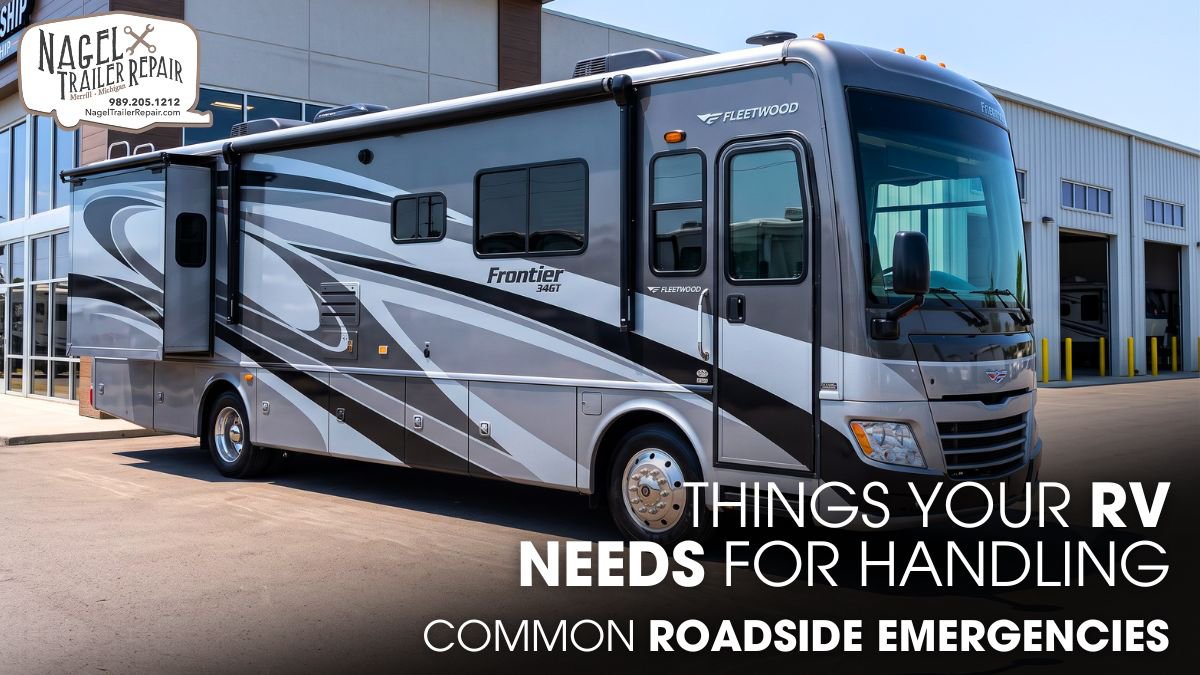
Before a roadside emergency turns into a major problem, your RV needs more than a full tank and a packed itinerary. The right emergency gear can help you handle unexpected tire issues, dead batteries, overheating, and minor mechanical problems with greater confidence.
An RV breakdown can quickly become stressful, especially when you’re far from a repair shop or traveling through unfamiliar roads. Without essential tools and safety equipment, even a manageable problem can leave you stranded and exposed to passing traffic.
This guide covers essential items your RV should carry for common roadside emergencies, says an RV expert in Michigan. From tire and battery supplies to warning devices and emergency contacts, you’ll learn what to keep onboard to respond quickly, stay safer, and get back on the road.
Build a Complete RV Emergency Kit:
An RV emergency kit should do more than help you tighten a loose bolt. It should give you enough equipment to identify a problem, make a safe temporary repair, protect the occupants, and communicate with someone who can provide additional help. An RV combines a heavy chassis with multiple electrical circuits, appliances, plumbing systems, and mechanical components, so a basic automobile tool kit often falls short.
Start with a quality socket and combination-wrench set that matches the fasteners used on your particular chassis. Add a breaker bar, adjustable wrench, locking pliers, screwdrivers, hex keys, utility knife, torque wrench, and penetrating lubricant. A compact inspection mirror and bright LED work light can also prove extremely useful when you need to inspect areas that remain hidden behind engine covers or body panels.
Electrical faults are common enough to justify carrying a digital multimeter. Choose one that can measure DC voltage, resistance, and continuity. Keep spare blade fuses, appropriately sized wire connectors, heat-shrink tubing, electrical tape, and wire cutters with it. These supplies can help you trace a simple open circuit or replace a damaged connector without resorting to unsafe wire twisting.
- Keep heavy-duty work gloves and safety glasses within easy reach.
- Carry a high-visibility vest for roadside work.
- Store a suitable automotive fire extinguisher near an accessible exit.
- Include a first-aid kit, headlamp, and spare batteries.
- Pack zip ties, duct tape, hose clamps, and absorbent rags.
Keep mechanical, electrical, and safety gear in separate, clearly labeled containers. This simple system helps you find the right tool without digging through every storage compartment. If you need help organizing or preparing your RV, an RV repair shop in Michigan can also provide practical guidance for safer roadside readiness.
Prepare for a Flat RV Tire:
A flat tire on an RV deserves immediate attention because the vehicle places considerably more load on each tire than a typical passenger car. Underinflation increases sidewall flex and heat generation, while overloading can push a tire beyond its intended operating conditions. Age, impact damage, valve problems, tread separation, and improper inflation can also contribute to failure.
Check tire pressure when the tires are cold, preferably before the day’s first drive. Use the inflation pressure appropriate for the tire’s actual load and the manufacturer’s specifications. Do not simply inflate every tire to the maximum pressure molded into the sidewall unless the required load pressure calls for it.
A tire-pressure monitoring system (TPMS) provides another layer of protection. A good system can alert you to rapid pressure loss and, depending on the model, abnormal tire temperature. Those warnings can give you an opportunity to slow down and stop before a small leak becomes a catastrophic failure.
Your emergency tire equipment should include:
- A jack rated for the RV’s actual weight.
- A heavy-duty lug wrench or breaker bar.
- A calibrated tire-pressure gauge.
- A portable compressor with suitable capacity.
- A correctly specified spare tire, where applicable.
- A temporary tire-plug kit for suitable tread punctures.
Before relying on the jack, identify the manufacturer’s approved lifting points. Never place a jack beneath an arbitrary suspension or body component. After installing a wheel, tighten the lug nuts in the specified sequence and use a torque wrench to reach the manufacturer’s torque specification.
Use plug kits only as temporary fixes for suitable tread punctures. Never plug a sidewall or reuse a tire with structural damage. After a major tire failure, have the wheel, brakes, valve stem, and nearby suspension checked for hidden problems. For proper inspection and follow-up, consider professional RV repairs in Michigan.
Handle Battery and Electrical Issues:
An RV can experience several different electrical failures, and identifying which system has failed saves considerable time. The engine starting circuit, house batteries, converter, inverter, solar controller, and 12-volt distribution system can all behave differently.
For starting problems, carry heavy-gauge jumper cables or a portable jump starter with enough output for your engine. Check the jump starter’s rated starting current against your engine requirements before purchasing one. A diesel engine typically demands significantly more cranking current than a small gasoline engine.
A multimeter can quickly separate a discharged battery from a charging or wiring problem. A conventional fully charged 12-volt lead-acid battery generally reads about 12.6–12.8 volts after resting without a significant load. A much lower reading suggests a discharged or potentially deteriorated battery. With the engine running, charging voltage should rise, although the correct value depends on the alternator and vehicle charging system.
Voltage-drop testing can reveal problems that a simple battery-voltage measurement misses. For example, a battery may show normal voltage while corrosion at a terminal or ground connection prevents sufficient current from reaching the starter. Measure voltage across the suspected connection while the circuit carries a load to identify excessive resistance.
- Carry replacement fuses with exactly the specified ratings.
- Inspect battery terminals for corrosion and looseness.
- Check chassis-ground connections during electrical troubleshooting.
- Never replace a blown fuse with a higher-rated fuse.
- Keep insulated tools available around energized components.
If your RV has lithium batteries, solar charging, an inverter/charger, or a battery-management system, always follow the manufacturer’s safety instructions for isolation. Lithium systems require different handling than traditional lead-acid setups. For guidance during electrical issues, consider mobile RV repairs in Michigan to ensure the system receives proper attention.
Prepare for Engine and Fluid Problems:
An overheating engine can turn a manageable cooling-system fault into a major mechanical failure within minutes. Low coolant, a damaged radiator hose, failed thermostat, defective cooling fan, slipping serpentine belt, or restricted radiator airflow can all raise engine temperature.
Before a long trip, inspect the engine compartment with a flashlight. Look for dried coolant deposits, wet oil residue, cracked hoses, swollen rubber sections, loose clamps, damaged belts, and frayed wiring. Check engine oil and coolant according to the manufacturer’s procedure because some systems require specific temperature conditions for accurate readings.
Carry only fluids that meet your engine and chassis specifications. Engine oils differ in viscosity and performance classifications, while coolant formulations can differ in chemistry and additive packages. Mixing incompatible products can reduce corrosion protection or damage components.
If the temperature gauge enters the critical zone, do not try to “make it a few more miles.” Pull over somewhere safe and shut the engine down when appropriate. Never remove a radiator cap or pressurized coolant reservoir cap while the system remains hot. Pressurized coolant can escape suddenly and cause severe burns.
- Carry the correct engine oil and approved coolant.
- Keep suitable spare hose clamps and basic replacement supplies.
- Carry a spare serpentine belt when practical.
- Store the belt-routing diagram with your tools.
- Keep a bright inspection light available.
Some roadside fixes aren’t safe for DIY. Fuel-system faults, pressurized systems, severe belt failures, and internal engine issues often need specialized tools. When that happens, searching for “RV repair near me” and calling a professional is wiser than improvising.
Stay Safe During a Roadside Breakdown:
Once an RV stops beside a busy road, the biggest hazard may no longer be mechanical. Passing traffic creates a serious secondary risk, particularly at night, during rain, or on narrow shoulders. Your first objective should always be to create as much separation as possible between people and moving vehicles.
If the RV remains controllable, move it completely off the travel lane and onto firm, stable ground. Turn on the hazard warning lights and deploy reflective triangles, LED warning devices, or other legally permitted equipment. Put on a high-visibility vest before leaving the vehicle.
Never work beneath an RV supported only by a jack. An RV’s mass can reach several tonnes, and a jack can shift, sink into soft ground, or lose hydraulic pressure. If you must perform work underneath the vehicle, use properly rated support equipment and approved structural support points.
- Keep passengers away from traffic and unstable shoulders.
- Never stand between the RV and passing vehicles.
- Avoid roadside repairs when visibility is poor.
- Keep your phone charged and accessible.
- Request professional assistance when conditions become unsafe.
Keep essential emergency tools in an easily accessible spot so you can grab them quickly without moving other gear. When handling repairs after dark, carry a headlamp or bright work light to clearly see the problem while staying alert to passing traffic. For additional roadside support, consider professional RV services in Michigan.
Keep Emergency Contacts and Plans Ready:
Good emergency preparation also means giving a technician the information needed to help you. Store roadside-assistance details, insurance information, vehicle identification numbers, emergency contacts, and relevant vehicle specifications in both digital and offline formats.
Record the RV’s chassis model, engine, transmission, GVWR, axle ratings, tire dimensions, and recommended inflation pressures. These details help a recovery company select the correct tow vehicle and equipment. Improper towing can damage driveline components, suspension parts, bodywork, or the underbody.
Create a simple pre-trip emergency checklist and actually use it. Test your jump starter, recharge flashlights, inspect your tools, check spare-tire pressure, and replace expired first-aid supplies. Do the same with fire extinguishers and other safety equipment.
- Confirm roadside-assistance coverage before long journeys.
- Record the RV’s dimensions and approximate operating weight.
- Check spare-tire pressure at regular intervals.
- Keep important vehicle specifications with the emergency kit.
- Replace damaged or expired emergency equipment.
Before starting your journey, inspect the tires, fluid levels, battery, lights, brakes, and check for any visible leaks. An RV specialist in Michigan can help identify worn or weak components before they cause trouble. Fixing small issues at home can help you avoid unexpected breakdowns on unfamiliar roads.
The Role of Professional Maintenance:
Professional maintenance helps keep an RV ready for unexpected roadside problems while reducing the chance of preventable failures. Qualified technicians can inspect tires, brakes, batteries, belts, hoses, fluid systems, and electrical connections before a small defect becomes a breakdown.
They can also identify worn components that may escape a routine visual check, verify correct torque and fluid specifications, and confirm that critical safety systems operate properly. Regular inspections give you greater confidence when traveling long distances or carrying heavy loads.
Maintenance also has a direct effect on fuel consumption. A technician can identify underinflated or mismatched tires, dragging brakes, dirty filters, fluid problems, and engine or transmission issues that force the powertrain to work harder.
Correct wheel alignment, scheduled fluid and filter changes, and proper engine calibration help the RV operate more efficiently. Combining professional inspections with sensible driving habits can reduce unnecessary fuel use while improving reliability and extending component life.
Conclusion:
A properly equipped RV can turn many roadside problems into controlled situations. Essential tools, tire equipment, electrical supplies, fluids, and safety devices give you the resources to diagnose problems and perform appropriate temporary repairs.
However, equipment alone does not guarantee safety. Know your RV’s electrical, mechanical, weight, and lifting limits, and never attempt a repair that creates greater risk than the original failure.
Before every big trip, check your emergency kit: replace expired supplies, test electronics, and keep key vehicle specs handy. For trusted help, turn to Nagel Trailer Repair, your go-to RV expert in Michigan. Prep smart, cut downtime, and travel safer. Contact us today to schedule your pre-trip inspection!