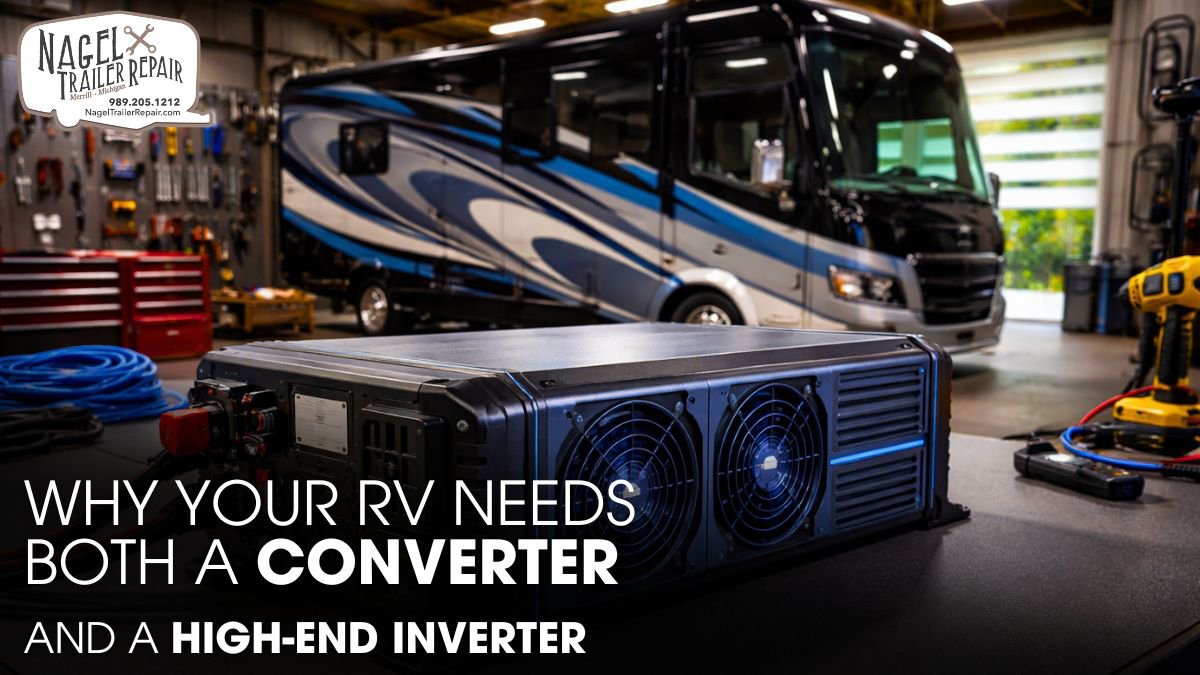
Imagine settling into your RV at a scenic campsite, only to discover that your appliances, batteries, or electronics are not getting the power they need. A reliable electrical system does more than keep the lights on—it ensures comfort, convenience, and peace of mind wherever you travel.
Many RV owners assume a converter or an inverter alone can handle every power requirement. In reality, each device serves a different purpose. Relying on only one can lead to limited functionality, battery issues, and frustration when you’re off-grid or switching between power sources.
The good news is that combining a converter with a high-end inverter creates a complete power solution. As any RV repair expert in Michigan will tell you, the right setup boosts efficiency and reliability. Professional RV shops can help ensure your system performs at its best for every journey.
Understanding RV Power Systems:
To understand why your RV needs both a converter and a high-end inverter, you first need to understand how RV electrical systems work behind the scenes.
Unlike a traditional home that depends almost entirely on utility power, an RV operates using two different electrical systems simultaneously: 120-volt alternating current (AC) and 12-volt direct current (DC). These systems power different equipment throughout the vehicle, yet they must work together seamlessly to deliver a comfortable camping experience.
Your microwave, air conditioner, television, coffee maker, and residential refrigerator typically run on AC power. Meanwhile, essential RV components such as LED lights, water pumps, furnace blowers, vent fans, control boards, and slide-out motors rely on DC power supplied by the battery bank.
This dual-voltage design gives RVs tremendous flexibility, but it also creates a challenge. Campground hookups provide AC electricity, while batteries store energy as DC electricity. Therefore, the system must constantly convert power between the two formats.
A modern RV electrical setup typically includes:
- Shore power connection
- AC breaker panel
- DC fuse panel
- Battery bank
- Converter
- Inverter
- Solar charging system (optional)
- Automatic transfer switch
Without proper power conversion, many RV systems would stop functioning when you switch power sources. That is precisely why both a converter and an inverter play such critical roles in the overall electrical architecture.
What an RV Converter Does?
The converter is one of the hardest-working components in an RV, even though most owners rarely think about it.
Whenever you connect your RV to shore power or run the auxiliary power source, the converter immediately begins transforming incoming 120V AC power into 12V DC power. This converted power supplies low-voltage RV systems while simultaneously recharging the battery bank.
Modern converters are far more sophisticated than earlier designs. Instead of delivering a constant voltage output, today’s smart converters continuously monitor battery conditions and adjust charging parameters to maximize efficiency and battery life.
Most premium converters use a multi-stage charging process that includes:
- Bulk charging for rapid energy replenishment
- Absorption charging for controlled charging completion
- Float charging for long-term battery maintenance
This charging strategy helps batteries accept energy efficiently while reducing heat buildup and minimizing long-term degradation.
From a technical standpoint, modern converters use switch-mode power supply technology. These systems operate at much higher efficiencies than older linear designs, often exceeding 90% efficiency. As a result, they waste less energy as heat and place less stress on electrical components.
Converter quality becomes especially important when using lithium batteries. Lithium Iron Phosphate (LiFePO4) batteries require specific charging voltages and charging profiles that differ significantly from lead-acid batteries. A converter designed for lithium chemistry can dramatically improve charging speed while extending battery lifespan.
In larger RVs, converters commonly provide charging capacities ranging from 45 amps to more than 100 amps. Higher charging output allows large battery banks to recover more quickly after extended periods of off-grid use.
What a High-End Inverter Does?
While the converter manages incoming power, the inverter allows your RV to create household electricity when external power is unavailable.
An inverter converts the 12V DC power stored in your batteries into 120V AC power that appliances can use. This capability is what makes off-grid camping practical and comfortable.
Without an inverter, your batteries could only power DC equipment. You would not be able to operate many of the appliances that make modern RV living convenient.
However, inverter quality matters significantly.
Entry-level modified sine wave inverters generate a stepped electrical waveform that differs substantially from utility power. While these units can operate basic devices, they often create issues for sensitive electronics and motor-driven appliances.
A high-end pure sine wave inverter produces electricity that closely replicates the power delivered by utility companies. This cleaner waveform helps appliances operate more efficiently and reliably.
Benefits of pure sine wave technology include:
- Better performance for sensitive electronics
- Reduced electrical interference
- Improved motor operation
- Lower heat generation
- Increased appliance longevity
- Greater compatibility with modern equipment
Internally, premium inverters use advanced pulse-width modulation (PWM), high-speed switching transistors, digital control circuitry, and sophisticated filtering systems to generate stable AC output.
Power demand calculations reveal just how important inverter design can be. For example, a 1,500-watt microwave operating through an inverter may require well over 140 amps from a 12V battery bank once efficiency losses are considered. Handling these large current loads safely requires robust internal components and advanced thermal management systems.
Many premium inverters also include:
- Automatic transfer switches
- Bluetooth monitoring
- Remote control panels
- Programmable operating modes
- Overload protection
- Short-circuit protection
- Low-voltage shutdown protection
These features improve both performance and user convenience.
Why One Device Isn’t Enough?
Many RV owners mistakenly believe they can choose between a converter and an inverter. In reality, the two devices solve completely different problems.
A converter only converts AC power into DC power. It can power DC circuits and recharge batteries while shore power is available, but it cannot create AC power from battery energy. Once you disconnect from shore power, the converter loses its source of electricity and becomes unable to support AC appliances.
An inverter faces the opposite limitation. It can generate AC power from batteries, but it cannot properly charge those batteries when shore power becomes available. This distinction becomes obvious in real-world camping situations.
Imagine spending several days at a campground with full hookups. During that time, the converter powers your lights, water pump, furnace controls, and battery charging system. Later, you move to a remote campsite without electrical hookups.
At that point, the inverter takes over and powers your television, laptop chargers, kitchen appliances, and other AC-powered devices.Without both components working together, you sacrifice flexibility and efficiency.
Relying solely on a converter means:
- No household AC power when off-grid
- Increased dependence on auxiliary power sources
- Reduced camping flexibility
Relying solely on an inverter means:
- No integrated battery charging solution
- Poorer battery management
- Additional charging equipment requirements
Modern RV electrical systems require both AC-to-DC and DC-to-AC conversion. Eliminating either function creates significant limitations.
Benefits of Using Both Together:
The real power of an RV electrical system becomes apparent when a converter and a high-end inverter work together as part of an integrated energy management strategy. When shore power is available, the converter handles battery charging and powers DC circuits. When shore power disappears, the inverter automatically begins supplying AC electricity from the battery bank.
Many modern systems perform this transition so quickly that connected appliances never notice the change.
This integrated approach offers several advantages:
- Continuous power availability
- Improved battery performance
- Greater energy independence
- Extended boondocking capability
- Reduced auxiliary power use
- Enhanced system reliability
Battery health improves significantly as well. Smart converters prevent overcharging and undercharging, while efficient inverters minimize unnecessary energy losses during discharge cycles.
For RV owners who use solar panels, the benefits become even greater. During daylight hours, solar panels recharge the batteries through a charge controller. The inverter then converts that stored energy into usable AC power for appliances. When shore power becomes available, the converter supplements charging and maintains battery readiness.
Many advanced RV electrical systems now include energy management platforms capable of providing:
- Real-time battery monitoring
- State-of-charge calculations
- Power consumption tracking
- Load prioritization
- Remote diagnostics
- System fault alerts
These technologies allow RV owners to manage energy consumption more effectively and maximize battery performance during extended trips.
Choosing the Right RV Power Setup:
Selecting the right converter and inverter involves much more than choosing the highest wattage rating available.
Start by evaluating your actual power needs. Consider both continuous electrical loads and startup loads. Continuous loads include devices such as televisions, refrigerators, and computers. Startup loads occur when appliances such as air conditioners, compressors, or microwaves initially turn on and demand a surge of power.
When choosing an inverter, focus on:
- Continuous wattage rating
- Surge wattage capacity
- Pure sine wave output
- Conversion efficiency
- Transfer switch functionality
- Safety and protection features
When selecting a converter, consider:
- Charging amperage
- Multi-stage charging capability
- Lithium battery compatibility
- Voltage regulation accuracy
- Temperature compensation
- Overall efficiency
Battery bank sizing is equally important. A powerful inverter connected to an undersized battery bank can cause excessive voltage drop, shorter runtimes, and accelerated battery wear.
Cable sizing also deserves careful attention. High-current DC systems can experience significant energy losses if wiring is undersized. Proper conductor sizing reduces voltage drop, improves efficiency, and enhances system safety.
If you plan to expand your setup later with additional batteries, solar panels, or larger appliances, choose equipment that supports future growth. Investing in higher-quality components today often saves money in the long run and reduces the need for costly upgrades.
A properly engineered RV electrical system should not only meet your current needs but also provide the reliability, efficiency, and scalability required for years of enjoyable travel.
The Role of Professional Maintenance:
Professional maintenance plays a crucial role in keeping your RV safe, efficient, and ready for the road. Experienced technicians can identify hidden electrical issues, test charging systems, inspect battery performance, and ensure power conversion equipment operates at peak efficiency. Regular inspections also help prevent voltage irregularities that can damage sensitive electronics and shorten battery life.
At the same time, professional roof maintenance helps protect your RV from costly water damage. Experts can spot early signs of mold growth, seal deterioration, moisture intrusion, and surface contamination before they become major problems. Routine cleaning, preventive treatments, and timely repairs preserve the roof’s integrity and extend its service life.
By investing in professional maintenance, RV owners reduce unexpected breakdowns, improve system reliability, and protect valuable components. A proactive maintenance strategy not only enhances performance but also helps maintain comfort, safety, and long-term value throughout every adventure.
Conclusion:
A converter and a high-end inverter serve fundamentally different but equally important roles within an RV electrical system. The converter manages AC-to-DC conversion and battery charging, while the inverter transforms stored battery power into usable AC electricity for everyday appliances.
Together, they create a resilient, efficient, and versatile power infrastructure that supports both campground hookups and off-grid adventures. Whether you’re a weekend traveler or a full-time RVer, don’t let electrical gremlins ruin your trip. Trust Nagel Trailer Repair, the RV repair expert in Michigan, for proactive system checks.
Investing in both components ensures reliable power delivery, healthier batteries, greater energy independence, and a more comfortable experience on the road—because peace of mind starts with professional care.