


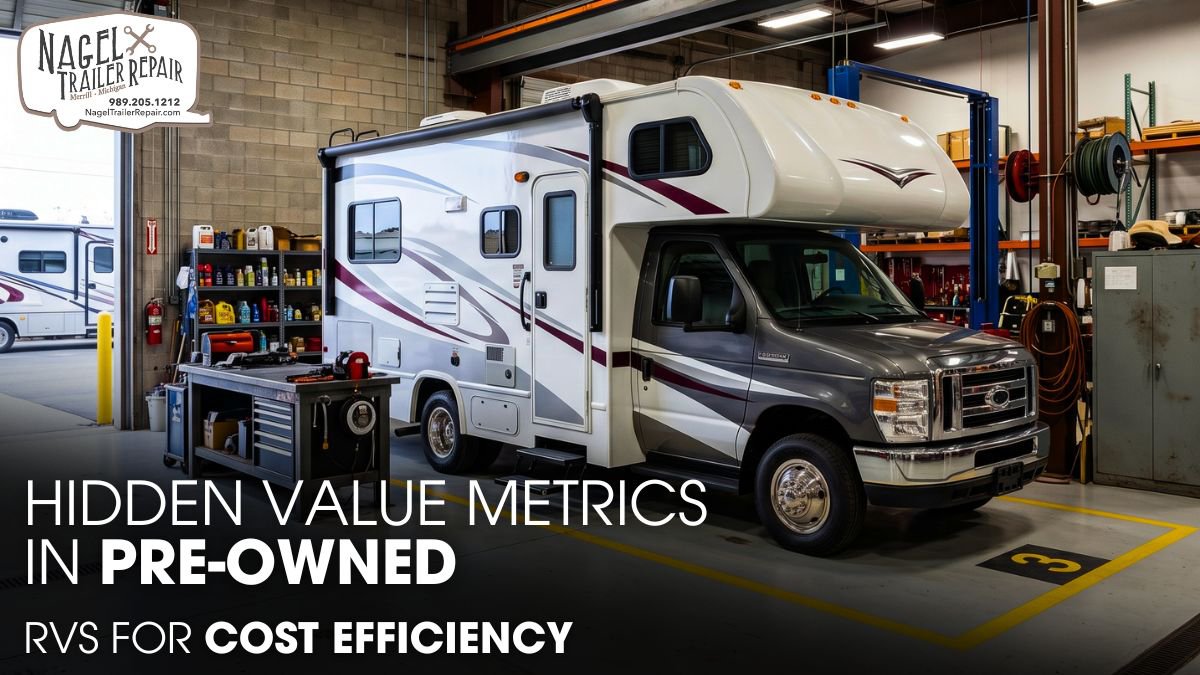
A pre-owned RV can look like a bargain at first glance, but the sticker price rarely tells the full financial story. Hidden value metrics such as maintenance history, depreciation, component condition, and resale potential can determine whether you are making a smart investment or buying future expenses.
The problem is that many buyers focus on purchase price while overlooking repair exposure, aging systems, roof condition, appliance performance, and ownership costs. A low-priced RV may quickly become expensive when deferred maintenance and major component replacements enter the equation.
This guide explains how to uncover the financial factors that determine an RV’s real value. Assess ownership costs, condition, depreciation, repairs, and resale potential with guidance from an RV expert in Michigan to make a smarter, cost-efficient purchase.
Purchase Price vs. Total RV Ownership Cost:
The asking price gives you only one piece of the financial picture. To judge a pre-owned RV properly, calculate its total cost of ownership (TCO). Include the purchase price, financing, insurance, storage, maintenance, repairs, registration, and expected depreciation.
Imagine two travel trailers priced at $40,000 and $47,000. The $40,000 unit may initially look like the better deal. However, if inspection reveals $3,000 in tires, $2,500 in roof work, $1,500 in battery and electrical repairs, and another $1,000 in overdue maintenance, the effective purchase cost reaches $48,000 before financing or insurance.
- Calculate immediate repair exposure before negotiating.
- Add annual maintenance to your ownership budget.
- Include storage and insurance in TCO.
- Keep a 5–10% contingency reserve for unexpected repairs.
This approach shifts the focus from simply asking which RV has the lower price to understanding which one offers better long-term ownership value. An experienced RV repair shop in Michigan can help assess maintenance costs, reliability, and potential repairs for a smarter financial decision.
RV Age, Mileage, and Depreciation:
Age and mileage can influence RV value, but neither metric tells the whole story. An RV that traveled very few miles can still develop serious age-related deterioration. Tires, roof sealants, batteries, plumbing seals, slide-out components, and exterior caulking can degrade from ultraviolet exposure, temperature fluctuations, moisture, and prolonged storage.
For motorhomes, evaluate engine mileage together with generator hours, transmission service, coolant condition, brake wear, and chassis maintenance. For towable RVs, examine axle alignment, suspension, brakes, wheel bearings, and tire age.
Use a simple depreciation calculation:
Depreciation % = (Original Value − Current Value) ÷ Original Value × 100
For example, if an RV originally cost $75,000 and now carries a market value of $48,000, it has lost $27,000, or 36%, of its original value.
- Compare the same model and floor plan.
- Separate normal depreciation from condition-based discounts.
- Check mileage against service documentation.
- Treat unusually long storage periods as a risk factor.
A well-maintained older RV can deliver better long-term value than a newer, neglected unit. With regular inspections, timely repairs, and dependable RV services in Michigan, owners can reduce unexpected expenses, improve performance, and extend the vehicle’s usable life. This makes maintenance a key factor in achieving genuine cost efficiency.
Maintenance History and RV Repair Costs:
Maintenance records reveal how the previous owner treated the RV. Look for dated invoices, inspection reports, tire receipts, generator service records, roof maintenance, appliance repairs, brake work, and battery replacement history. A documented repair is usually easier to evaluate than an undocumented system that merely appears functional.
Pay special attention to deferred maintenance. If the previous owner postponed roof sealing, tire replacement, brake service, or water-system repairs, you inherit those costs immediately after purchase.
Professional pre-purchase inspections commonly examine roof condition, slides, electrical systems, plumbing, propane, appliances, chassis, and structural components.
- Separate routine maintenance from major repairs.
- Look for repeated failures of the same component.
- Verify service dates against mileage or generator hours.
- Convert every known defect into a dollar estimate.
For example, if an inspection reveals $6,500 in deferred repairs on a $45,000 RV, that cost should influence your negotiation. An RV specialist in Michigan can help assess the potential liability, because the vehicle may represent a $51,500 financial commitment rather than a $45,000 purchase.
Roof, Appliances, and System Condition:
The roof deserves serious attention because a small sealing failure can develop into expensive structural damage. Inspect membrane seams, vents, skylights, antenna mounts, air-conditioner openings, front and rear caps, and sidewall termination points. Look for cracked sealant, bubbling membrane, staining, soft areas, delamination, and evidence of previous patching.
Moisture intrusion can damage insulation, wall framing, flooring, cabinetry, and electrical components. Professional inspection guidance specifically recommends checking roof sealant, soft spots, slide seals, and signs of water intrusion rather than relying on cosmetic appearance.
Test every major system instead of accepting “everything works” as proof.
- Run the furnace and air conditioner through complete cycles.
- Test the refrigerator and water heater.
- Pressurize the plumbing and inspect for leaks.
- Operate every slide-out, awning, and leveling system.
- Test 12-volt DC and 120-volt AC electrical circuits.
Also consider replacement exposure. A working $1,200 air conditioner nearing the end of its service life can become a future financial burden. The same applies to refrigerators, water heaters, generators, batteries, and slide-out motors. Planning for these costs with professional RV repairs in Michigan can improve long-term ownership value.
Resale Value and Market Demand:
The purchase decision should also consider how easily you can sell the RV later. Calculate your net ownership cost using:
Net Ownership Cost = Purchase Cost + Ownership Expenses − Resale Proceeds
Suppose you buy an RV for $50,000, spend $11,000 on maintenance, repairs, insurance-related ownership expenses, and improvements, and later sell it for $35,000. Your simplified ownership cost becomes $26,000.
Resale strength depends on more than age. Buyers typically respond to condition, floor plan, documentation, system functionality, tire age, exterior appearance, and evidence of water damage.
- Compare prices for equivalent models and floor plans.
- Preserve service invoices and inspection reports.
- Repair functional defects before resale.
- Avoid unnecessary upgrades that do not improve market value.
A well-documented maintenance history can add real financial value to a pre-owned RV. Buyers gain confidence when they see consistent care and timely servicing. Choosing mobile RV repairs in Michigan can also help owners maintain service records, strengthen resale appeal, and reduce concerns during price negotiations.
Cost Efficiency Through Value Metrics:
A reliable way to assess an RV combines multiple factors into a single value model. An RV Value Score can weigh condition, maintenance history, age, repair costs, and resale potential. When searching for “RV repair near me”, these factors can also help you identify maintenance needs and make a smarter investment decision.
For example:
- Purchase price: 20%
- Mechanical condition: 20%
- Roof and structure: 20%
- Maintenance history: 15%
- Depreciation: 15%
- Resale potential: 10%
Score each category from 1 to 10, then apply the weighting. An RV with a low purchase price but severe roof deterioration should not automatically beat a more expensive unit with excellent structural condition.
Tires provide a good example of why hidden metrics matter. An RV can have excellent tread but aging rubber. NRVIA notes that tire replacement can range from roughly $500 for some fifth wheels or travel trailers to $10,000 or more for large Class A motorhomes.
For a $40,000 RV, setting aside $4,000–$6,000 for initial readiness and unexpected repairs can provide a practical financial buffer. The exact reserve should depend on inspection results, age, component condition, and maintenance records.
The goal is not to find a perfect RV. The goal is to understand the financial consequence of every defect before you buy. When you quantify repair exposure, remaining component life, depreciation, and resale potential, you can negotiate from evidence instead of emotion.
The Role of Professional Maintenance:
Professional maintenance helps uncover the costs that a pre-owned RV may hide behind a clean exterior and attractive price. A skilled technician can inspect the roof, seals, tires, brakes, electrical circuits, plumbing, appliances, chassis, and structural components before small defects become expensive repairs.
Detailed service records also help owners estimate future maintenance costs, protect resale value, and make better purchasing decisions based on actual vehicle condition rather than appearance alone.
Suspension maintenance also plays a major role in controlling an RV on the road. Proper shock absorber tuning helps manage rebound, compression, body movement, and weight transfer, especially when the RV carries varying loads.
A technician can evaluate shock condition, suspension geometry, ride height, bushing wear, and axle loading to determine whether the damping setup matches the vehicle. Correct tuning can improve stability, steering response, tire contact, and overall driving confidence.
Conclusion:
A cost-efficient pre-owned RV is not necessarily the cheapest RV on the market. The better purchase combines a defensible acquisition price with healthy structural, mechanical, electrical, plumbing, and safety systems. Evaluating these factors converts hidden technical risks into measurable financial variables.
Use TCO, depreciation, maintenance history, component life, repair exposure, and resale potential to calculate the RV’s real economic value. This method also strengthens negotiations because you can justify your offer using documented costs rather than assumptions.
Ultimately, the strongest RV investment is the one that minimizes surprise expenses while preserving future resale value. A detailed inspection before purchase can uncover expensive deficiencies—and that’s where Nagel Trailer Repair excels. As a trusted RV expert in Michigan, we’ll help you determine whether the RV represents genuine long-term cost efficiency. Don’t guess—schedule your expert assessment today!