

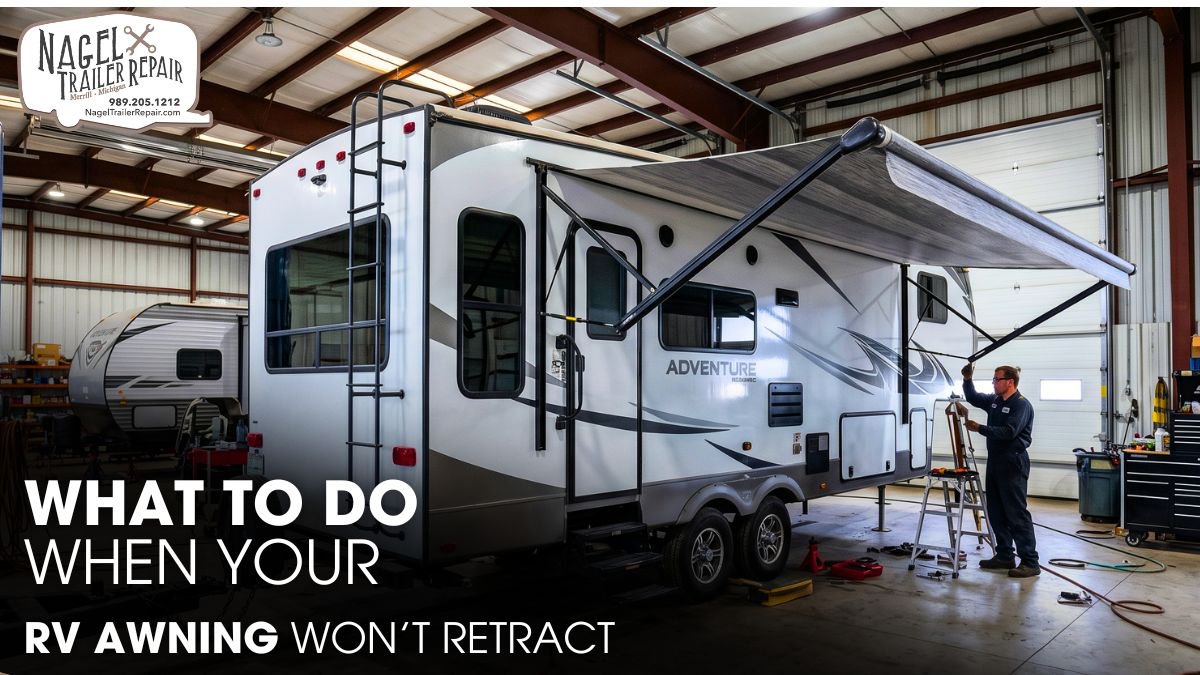
Nothing disrupts an RV trip faster than an awning that refuses to retract. Whether you’re preparing to get back on the road, packing up after a campsite stay, or trying to protect your RV from approaching bad weather, a stuck awning can quickly create frustration and delay your plans.
RV awnings can fail to retract for several reasons, including power supply issues, faulty switches, damaged motors, mechanical obstructions, or worn components. When left unresolved, the problem can expose the awning to wind, rain, and other hazards, potentially leading to more extensive damage and expensive repairs.
This guide explains why your RV awning is stuck and how to fix it safely. Learn practical troubleshooting and manual retraction methods while knowing when to call an RV specialist in Michigan. Timely professional repairs can prevent bigger issues and keep your trailer travel-ready.
Common Reasons an RV Awning Gets Stuck:
When an RV awning refuses to retract, the issue usually goes beyond a simple mechanical hiccup. Modern RV awnings combine electrical, mechanical, and structural systems that must work together precisely. If one component fails, the entire retraction process can stop.
Most powered awnings operate using a 12-volt DC motor connected to a gear reduction system. This motor generates torque that rotates the roller tube and winds the awning fabric back into its stored position. If the system cannot generate enough force or encounters excessive resistance, the awning may stall, retract unevenly, or stop completely.
Several factors commonly contribute to retraction problems:
- Weak or discharged RV batteries
- Corroded electrical terminals
- Blown fuses or faulty circuit breakers
- Defective wall switches
- Damaged drive motors
- Stripped gearbox components
- Bent support arms
- Roller tube misalignment
- Fabric tracking issues
- Debris trapped in moving parts
Environmental exposure also plays a significant role. UV radiation gradually weakens materials, moisture promotes corrosion, and road vibrations loosen hardware over time. Even a small alignment issue can create enough resistance to prevent proper operation.
Before attempting repairs, understanding the source of the problem helps prevent unnecessary component replacement and reduces the risk of causing additional damage.
Perform Basic Safety Checks:
Safety should always come first when working on an RV awning system. Although awnings appear simple from the outside, they contain moving arms, spring-loaded assemblies, electrical circuits, and heavy structural components that can create hazards during inspection or repair.
Start by positioning the RV on stable, level ground. Uneven terrain can place additional stress on the awning frame and affect troubleshooting accuracy. Engage the parking brake and ensure the vehicle remains secure throughout the inspection.
Next, perform a visual assessment of the entire awning assembly. Look closely at the mounting brackets, support arms, roller tube, and fabric. Damage in any of these areas can interfere with smooth retraction.
Pay attention to signs such as:
- Bent or twisted support arms
- Loose mounting hardware
- Cracked brackets
- Torn awning fabric
- Rust or corrosion
- Uneven roller tube positioning
Fabric condition deserves special attention. Wrinkled or stretched fabric can bunch up during retraction and create excessive drag. Water damage can also weaken the material and affect how it rolls onto the tube.
Weather conditions matter as well. Strong winds can place substantial force on an extended awning and increase the risk of sudden movement while you work. If severe weather approaches, focus first on securing the awning using manual methods.
Before inspecting electrical components, disconnect power if the manufacturer’s guidelines recommend doing so. This precaution helps prevent accidental motor activation and protects sensitive electronic components during troubleshooting.
A careful safety inspection often reveals obvious problems before you spend time performing advanced diagnostics.
Troubleshoot Electrical Issues:
Electrical faults represent one of the most common reasons an RV awning fails to retract. Since modern awnings rely heavily on electronic controls and motor-driven systems, even a minor electrical interruption can stop operation completely.
Begin with the RV battery. The awning motor requires sufficient voltage and current to generate the torque needed to retract the fabric and move the support arms. A battery that appears functional may still struggle under load.
Use a digital multimeter to measure battery voltage:
- 12.6V–12.8V generally indicates a fully charged battery
- 12.2V–12.4V suggests a partially discharged battery
- Below 12.0V often indicates insufficient power
However, voltage readings alone do not always tell the full story. Batteries can show acceptable voltage while failing to provide adequate amperage under load. If the motor clicks, slows down, or stops midway, battery performance may still be the culprit.
Next, inspect the wiring system. RVs experience constant vibration while traveling, which can loosen connections and damage wiring over time. Examine wires leading to the switch, control module, and motor.
Look for:
- Frayed insulation
- Corroded terminals
- Loose connectors
- Burned wiring
- Evidence of moisture intrusion
Corrosion significantly increases electrical resistance and reduces current flow. Even a small amount of corrosion at a terminal can prevent the motor from receiving enough power.
Check all fuses and circuit breakers associated with the awning circuit. Rather than relying solely on visual inspection, use a multimeter to verify continuity. Some damaged fuses may appear intact while failing electrically.
Many modern awnings include electronic control modules that manage motor operation and sensor input. If the control board malfunctions, the motor may never receive the command to retract. In such cases, diagnostic testing often requires manufacturer-specific procedures.
Ground connections also deserve careful inspection. A poor ground can create symptoms that mimic motor failure, switch failure, or battery problems. Verify that all grounding points remain clean, secure, and corrosion-free.
Try Manual Retraction Methods:
If electrical troubleshooting does not restore operation, the next step involves using the awning’s manual override system. Manufacturers design these systems specifically for emergency situations when electrical components fail.
Manual override mechanisms vary between brands and models. Some use a hand crank, while others require a socket wrench, hex key, or cordless drill attachment. Consult the owner’s manual before attempting manual operation.
Before engaging the override mechanism, inspect the awning for visible obstructions. Branches, debris, bent hardware, or misaligned fabric can create resistance that makes manual retraction difficult.
When manually retracting the awning:
- Apply steady, controlled force
- Monitor arm movement continuously
- Keep the fabric aligned
- Avoid sudden jerking motions
- Stop immediately if resistance increases
If the system becomes unusually difficult to operate, investigate the cause rather than forcing the mechanism. Excessive force can damage gears, bend structural components, or worsen existing problems.
Many RV awnings use torsion springs to assist movement. These springs store considerable mechanical energy and can cause sudden movement if damaged. Always exercise caution when working near spring-loaded assemblies.
Once the awning retracts fully, secure it according to the manufacturer’s recommendations. Travel locks, retaining straps, or locking mechanisms help prevent accidental deployment while driving.
Remember that manual retraction addresses the symptom rather than the underlying cause. After securing the awning, continue diagnosing the original failure to prevent future issues.
Address Mechanical Problems:
Mechanical failures often develop gradually. Many RV owners notice minor symptoms—such as slower operation or unusual noises—long before complete retraction failure occurs.
The support arm system represents one of the most important mechanical assemblies. These arms guide movement and maintain proper geometry throughout the retraction cycle. If an arm bends even slightly, the system can bind and create excessive resistance.
Inspect the support arms carefully for:
- Twisting
- Bowing
- Cracks
- Loose pivot points
- Excessive movement
Uneven arm movement often indicates alignment problems. If one side retracts faster than the other, the roller tube may experience uneven loading, which can eventually damage the motor or gearbox.
The roller tube itself also requires close examination. A perfectly functioning motor cannot compensate for a bent or damaged roller tube. As the tube rotates, any deformation can create uneven fabric winding and excessive friction.
Listen for mechanical warning signs such as:
- Grinding noises
- Squeaking sounds
- Clicking during operation
- Jerky movement
- Sudden stops
Bearings located at the ends of the roller tube can wear over time. When bearings deteriorate, friction increases significantly and places additional strain on the drive system.
Fabric alignment issues frequently contribute to retraction failures. If the fabric shifts sideways within the awning rail, it may bunch up as it rolls onto the tube. This condition creates resistance and may trigger overload protection systems in certain powered awnings.
Regular lubrication helps maintain smooth operation, but only when performed correctly. Apply manufacturer-approved lubricants to pivot points, hinges, and designated moving components. Excess lubricant can attract dust and debris, which may accelerate wear instead of reducing it.
By addressing mechanical issues early, RV owners can often avoid costly motor replacements and major structural repairs.
When to Call an RV Specialist?
While many awning problems can be diagnosed and resolved by experienced RV owners, certain failures require professional expertise and specialized equipment.
One of the clearest indicators that professional service is necessary involves torsion spring damage. These springs store large amounts of energy and can cause serious injury if handled improperly. Specialized training and tools are essential when servicing these components.
Professional assistance is also advisable when dealing with:
- Burned-out motors
- Damaged control boards
- Structural mounting failures
- Bent roller tubes
- Extensive wiring damage
- Persistent electrical faults
Technicians use advanced diagnostic tools to evaluate voltage drops, motor performance, current draw, control module functionality, and circuit integrity. These tests often reveal issues that remain hidden during basic inspections.
Professional inspections also assess structural attachment points. Over time, repeated loading and vibration can weaken the areas where the awning mounts to the RV wall. If these mounting points fail, the entire assembly can detach during operation or while traveling.
Preventive maintenance remains the best defense against major repairs. An annual inspection should include electrical testing, hardware tightening, lubrication verification, arm alignment checks, and fabric evaluation.
Routine maintenance provides several long-term benefits:
- Improved system reliability
- Longer component lifespan
- Lower repair costs
- Enhanced travel safety
- Reduced risk of emergency failures
Investing in regular maintenance helps ensure that the awning operates smoothly whenever you need it and minimizes the likelihood of unexpected breakdowns during your travels.
The Role of Professional Maintenance:
Professional maintenance plays a critical role in preserving the safety, appearance, and long-term performance of any RV. Skilled technicians can identify hidden issues within awning motors, wiring systems, support arms, and mechanical components before they develop into costly failures.
Regular inspections also help ensure smooth operation and reduce the risk of unexpected breakdowns during travel. Beyond mechanical systems, professionals can evaluate and restore damaged surfaces, helping protect the RV exterior paint from further deterioration caused by UV exposure, moisture, road debris, and oxidation.
By addressing minor defects early, applying proper repair techniques, and performing routine preventive maintenance, owners can extend the lifespan of key RV components, maintain vehicle value, and enjoy a more reliable and trouble-free travel experience.
Conclusion:
An RV awning that won’t retract is more than a convenience issue—it can become a safety concern and expose your RV to unnecessary damage. By systematically checking power sources, electrical components, manual override systems, and mechanical assemblies, you can identify the root cause and often resolve the problem before it worsens.
When major structural, spring, or motor failures affect your awning, seeking professional help is the safest and most reliable solution. Experienced teams like Nagel Trailer Repair can identify hidden issues and perform lasting repairs that help prevent future problems.
By working with an RV specialist in Michigan and scheduling regular inspections and preventive maintenance, you can keep your awning functioning properly, avoid costly breakdowns, and travel with greater confidence and peace of mind.