


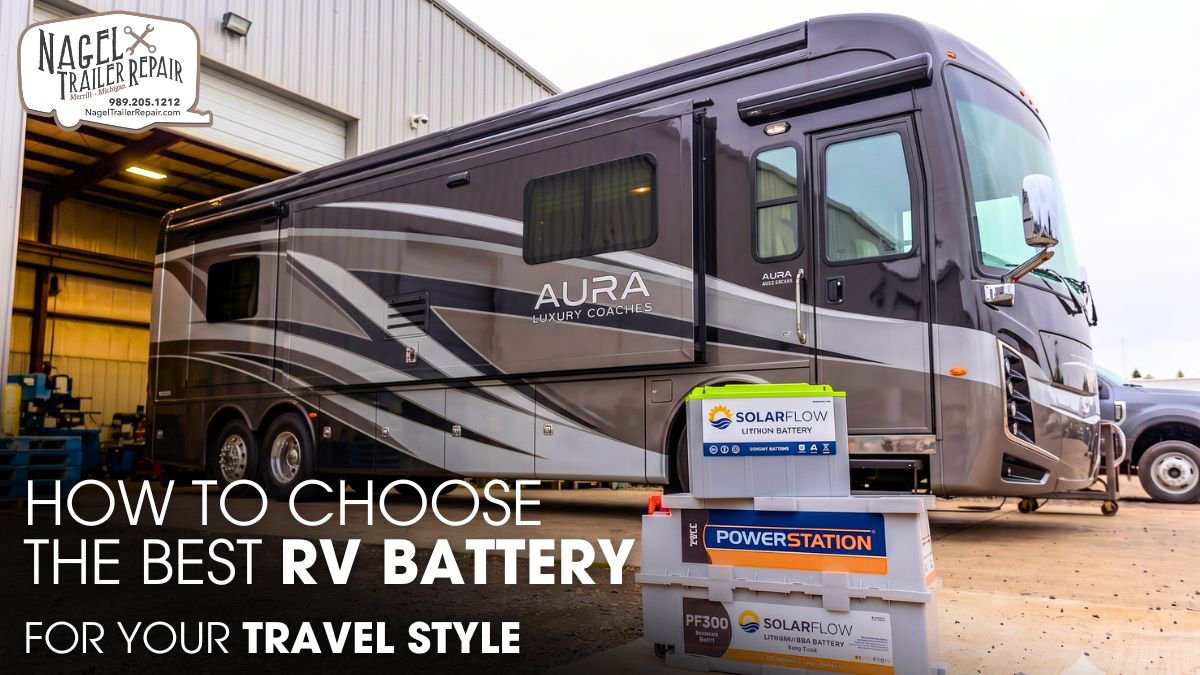
Your RV battery powers more than lights—it keeps your adventures moving. Whether you enjoy weekend getaways, long road trips, or remote camping, the right battery can make every journey smoother and more reliable.
But choosing an RV battery can quickly become confusing. Different battery types, capacities, lifespans, charging needs, and price points make it difficult to know which option truly fits your travel style. The wrong choice can lead to poor performance and unexpected power shortages.
This guide makes the decision easier. Learn how to match battery type, capacity, durability, and charging performance to your RV lifestyle—with insights from an RV expert in Michigan. Choose a dependable power source, then trust professional repair services to install it safely, keeping your adventures powered and worry-free for miles ahead.
Understand Your RV Battery Needs:
The first step involves measuring your actual electrical demand. Do not start by buying the largest battery that fits the compartment. Instead, calculate how much energy your RV consumes during a typical day. List every electrical load, including LED lights, water pumps, ventilation fans, refrigerators, televisions, laptops, phones, CPAP equipment, and inverter-powered appliances. Record each device’s wattage and estimate how many hours you use it.
Use this basic equation: Watt-hours (Wh) = Watts (W) × Operating Hours (h)
Then convert energy into battery capacity: Amp-hours (Ah) = Watt-hours ÷ System Voltage
For example, if your RV consumes 1,500 Wh per day on a nominal 12 V system, you need approximately 125 Ah of theoretical capacity. Real-world battery sizing requires additional capacity because conversion losses, temperature, discharge rate, aging, and reserve requirements affect usable energy.
- Calculate energy consumption for each appliance.
- Include inverter losses for AC equipment.
- Add a reserve for unexpected electrical demand.
- Separate house loads from engine-starting loads.
- Calculate capacity for the number of off-grid days you need.
A 20–30% design margin can give an RV electrical system greater operating flexibility and help handle unexpected power demands. However, the ideal reserve depends on your travel habits, electrical setup, and battery manufacturer’s specifications.
For reliable performance, proper sizing and installation matter. An experienced RV repair shop in Michigan can inspect your electrical system, identify potential issues, and recommend practical upgrades. Professional RV repair services help protect your investment and keep your travels safer and more dependable.
Compare RV Battery Types:
Battery chemistry determines how much energy you can use, how quickly you can recharge, how much maintenance the battery requires, and how many cycles it can withstand.
Flooded lead-acid batteries remain attractive because they usually cost less initially. However, they require ventilation and electrolyte maintenance, and deep discharges can accelerate degradation. AGM batteries use an absorbent glass mat to immobilize the electrolyte. They eliminate routine watering and offer better resistance to vibration, making them useful for many RV applications.
LiFePO4, or lithium iron phosphate, changes the equation. Lithium batteries generally provide more usable capacity from the same nominal Ah rating, weigh considerably less, accept higher charging currents, and support substantially more deep cycles when properly operated. Victron notes that LiFePO4 batteries can weigh roughly 30–60% less than comparable lead-acid batteries.
As a practical budgeting example, an RV owner might encounter approximate prices around $100–$200 for a 100 Ah flooded lead-acid battery, $150–$300 for a 100 Ah AGM battery, and $300–$600 or more for a quality 100 Ah LiFePO4 battery, depending on specifications, BMS features, heating, warranty, and brand.
Do not evaluate an RV battery by price alone. A $450 lithium battery may offer better long-term value through greater usable capacity and a longer cycle life, especially for frequent travelers. Choosing the right battery and ensuring proper installation can prevent costly electrical issues.
For dependable RV repairs in Michigan, trust experienced technicians to inspect, maintain, and optimize your RV’s power system for safer, more reliable adventures.
- Flooded lead-acid: lowest initial cost.
- AGM: sealed, maintenance-free lead-acid option.
- LiFePO4: high usable capacity and cycle life.
- Compare usable energy rather than rated Ah alone.
- Check the manufacturer’s cycle-life conditions.
Match Batteries to RV Travel Styles:
Your travel style determines how aggressively you cycle the battery. A weekend camper who plugs into shore power every night has different requirements from a boondocker who spends four days in a remote location.
For example, imagine a camper consumes 1,200 Wh daily. Two days without shore power require approximately 2,400 Wh. At 12 V, that equals about 200 Ah of theoretical storage.
A lead-acid bank should generally operate at a shallower depth of discharge to preserve service life, while many LiFePO4 batteries can provide a much larger percentage of their rated capacity. Some current LiFePO4 designs specify 80–100% usable DoD, but you should always follow the battery manufacturer’s limits.
Weekend travelers can therefore prioritize affordability, while frequent boondockers should emphasize usable capacity, charging speed, cycle life, and energy efficiency.
- Weekend camping favors simple, economical systems.
- Long trips reward faster recharge capability.
- Boondocking demands high usable energy reserves.
- Full-time RVers should prioritize cycle life.
- Solar users should balance storage with daily solar production.
Your RV’s battery bank should match its charging system. If storage exceeds what your solar panels, alternator, generator, or shore power can supply, the batteries may stay undercharged and lose efficiency. An RV specialist in Michigan can inspect your complete power setup, identify charging issues, and recommend reliable repairs or upgrades. Professional service helps protect your investment and keeps your RV ready for every trip.
Check Key RV Battery Specifications:
A battery’s Ah rating tells only part of the story. You also need to examine voltage, continuous discharge current, surge capability, maximum charge current, operating temperature, dimensions, weight, terminal configuration, and protection circuitry.
Consider a 2,000 W inverter operating from a 12 V battery. The theoretical current requirement is:
2,000 W ÷ 12 V = 166.7 A
Because an inverter cannot operate at 100% efficiency, the real DC current can exceed that figure. A battery with insufficient continuous-current capability may trigger its BMS protection or experience excessive voltage drop.
Manufacturers specify these limits differently. One current 100 Ah LiFePO4 datasheet, for example, lists 100 A continuous discharge, 200 A surge for 30 seconds, 3,000–5,000 cycles, and a built-in BMS.
Temperature also matters. Lithium batteries require special attention during freezing conditions because charging a lithium cell below its permitted temperature can cause permanent damage. Modern systems may use low-temperature cutoff protection or integrated heating.
- Verify continuous and peak current ratings.
- Match inverter demand to BMS capability.
- Check maximum charging current.
- Measure the installation compartment first.
- Confirm temperature operating limits.
- Consider battery-monitoring capability.
Never treat cable sizing and overcurrent protection as optional. High-cuNever overlook cable sizing or overcurrent protection in your RV’s electrical system. Properly rated fuses, disconnects, conductors, terminals, and busbars help prevent dangerous faults and costly damage.
If your power system needs inspection, upgrades, or repairs, choosing mobile RV repairs in Michigan brings professional help directly to your RV. Get expert service to keep your electrical system safe, reliable, and travel-ready.rrent DC systems can deliver extremely large fault currents, so the battery bank needs correctly rated fuses, disconnects, conductors, terminals, and busbars.
Consider Budget and Battery Life:
A smart RV battery choice goes beyond the upfront price. Consider usable capacity, cycle life, and long-term value before investing. For reliable performance, turn to trusted RV services in Michigan for professional battery checks, repairs, and system maintenance that keep your RV ready for the road.
Suppose you spend $200 on an AGM battery and conservatively use 50% of its 100 Ah rating. At 12 V, that provides roughly 600 Wh of usable energy under the simplified calculation. A $450 LiFePO4 battery providing 90% usable capacity could deliver approximately 1,080 Wh from the same nominal 100 Ah rating.
That comparison does not automatically make lithium the better purchase, because actual service life depends on temperature, charging profile, discharge depth, current, storage conditions, and product quality. However, frequent RV users can justify the higher upfront price when they repeatedly cycle the battery.
Also budget for supporting hardware. A lithium conversion may require a compatible converter/charger, DC-to-DC charger, solar-controller configuration, monitoring equipment, cabling, fusing, or other system changes. Victron specifically recommends checking shore-power, alternator, and solar charging compatibility before converting from lead-acid to lithium.
- Compare dollars per usable watt-hour.
- Estimate replacement costs over several years.
- Include installation and charging upgrades.
- Factor warranty coverage into the purchase.
- Consider maintenance and downtime costs.
Choose the Right RV Battery:
Once you know your energy consumption, travel pattern, battery chemistry, and budget, evaluate the battery as part of the entire RV electrical architecture. Your converter or inverter/charger must use an appropriate charging profile. Your solar charge controller must support the selected chemistry.
If you charge from the tow vehicle or motorhome alternator, verify that the charging circuit can safely deliver the required current. Lithium installations often benefit from a properly sized DC-to-DC charger because the charger can regulate current between the vehicle charging system and house battery.
For solar-equipped RVs, an MPPT controller can optimize energy harvesting by continuously tracking the solar array’s maximum power point. The controller must still match the battery’s voltage and charging requirements.
A battery-management system adds another protection layer to LiFePO4 installations. Depending on the product, the BMS can protect against overvoltage, undervoltage, excessive current, short circuits, and unsafe temperatures.
Before purchasing, run through this technical checklist:
- Calculate daily Wh consumption.
- Convert required energy into usable Ah.
- Determine your maximum inverter load.
- Verify battery continuous-current capability.
- Confirm charger compatibility.
- Check solar-controller settings.
- Evaluate alternator charging requirements.
- Select correctly rated fuses and cables.
- Confirm physical fit and weight limits.
- Check cold-weather charging protection.
The right RV battery must work seamlessly with your electrical system to provide reliable power and efficient storage. For dependable performance and safe installation, trust an experienced technician. If you’re searching for “RV repair near me”, professional service can keep your RV ready for every journey.
The Role of Professional Maintenance:
A dependable RV power system needs more than the right battery. Professional technicians can inspect battery terminals, wiring, charging circuits, converters, inverters, and solar connections to identify resistance, voltage-drop, corrosion, or charging problems before they cause a roadside failure.
They can also verify battery capacity, BMS operation, fuse ratings, cable sizing, and secure mounting, helping the entire electrical system operate safely and efficiently. Professional maintenance also becomes valuable after an accident or covered repair. Choose an RV repair facility that understands insurance documentation, estimates, claim procedures, and direct communication with insurers.
Experienced technicians can document structural and electrical damage accurately, recommend manufacturer-appropriate repairs, and coordinate the required paperwork. This approach reduces delays, prevents overlooked damage, and helps restore your RV to dependable operating condition with less hassle.
Conclusion:
The best RV battery depends on how you travel, how much electricity you consume, and how often you operate away from shore power. Start with measurable energy requirements rather than marketing claims or battery size alone.
AGM can provide economical performance for occasional camping, while LiFePO4 can deliver higher usable capacity, lower weight, faster charging, and substantially longer cycle life for demanding RV applications.
Treat your RV battery as part of an integrated power system—match chemistry, capacity, charger, and protections. But even the best setup needs pro care. For diagnostics or upgrades, trust Nagel Trailer Repair, the RV expert in Michigan, to keep your power reliable and costs low. Schedule your inspection today!