
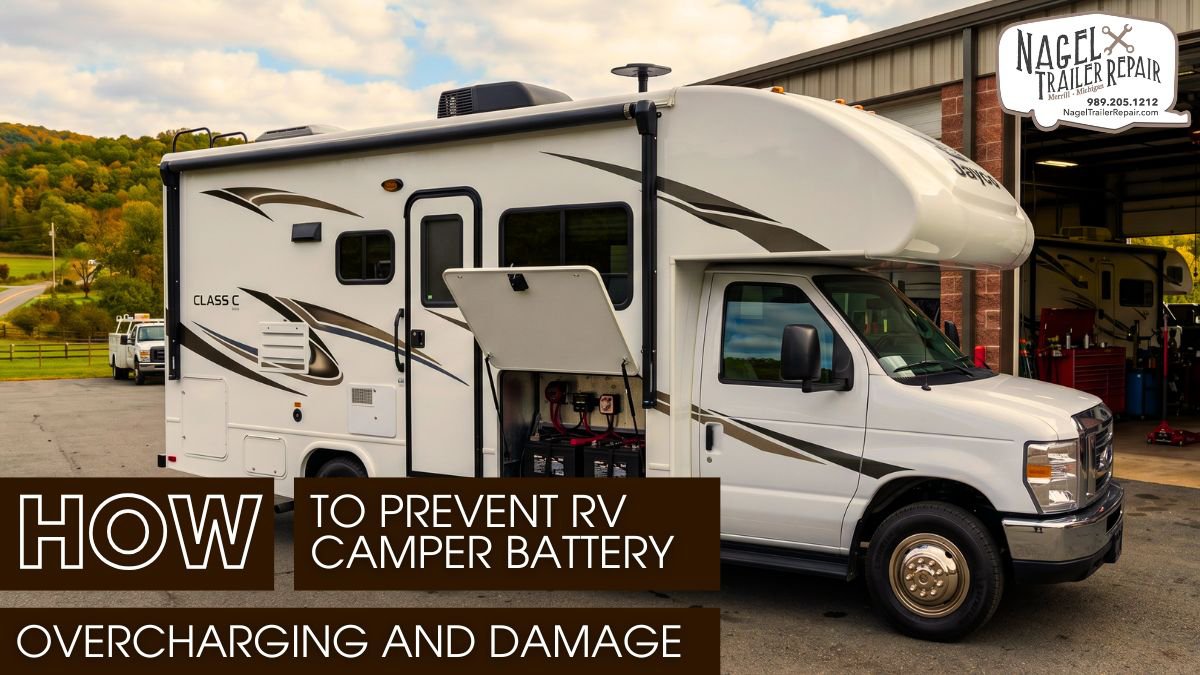
Your RV battery is the silent powerhouse behind every trip—but one wrong charge can cut your adventure short. Many RV owners overlook how quickly overcharging can turn a reliable battery into a costly failure, often without obvious warning signs.
Overcharging builds excess heat, drains essential fluids, and shortens battery life. Faulty chargers, poor monitoring, or simple user errors can trigger damage that leaves you stranded or facing expensive replacements when you least expect it.
This guide helps prevent RV battery overcharging to keep your travels safe. For expert maintenance and RV camper repairs in Michigan, our pros ensure your gear lasts. Don’t risk a breakdown; book a professional tune-up for a worry-free journey!
RV Camper Battery Basics:
Your RV battery does far more than just “store power.” It acts as a dynamic energy system that constantly balances charging and discharging. Unlike a car battery that delivers short bursts of current, RV batteries are deep-cycle units built to supply steady power over long periods. That difference makes proper charging absolutely critical.
Each battery type behaves differently under charge. Flooded lead-acid batteries can tolerate some abuse but lose water and degrade internally if you overcharge them. AGM and gel batteries are sealed, so excess pressure and heat have nowhere to go—damage happens faster. Lithium iron phosphate (LiFePO₄) batteries are more efficient, but they rely heavily on precise voltage control and internal protection systems.
Voltage is where most people go wrong. A “12V battery” doesn’t actually charge at 12 volts.
During charging, voltage rises significantly depending on the stage:
- Bulk charging pushes voltage to roughly 14.2–14.8V (lead-acid)
- Absorption holds voltage steady while current drops
- Float reduces voltage to around 13.2–13.6V
If your system stays above these limits too long, you’re overcharging—plain and simple.
A few technical fundamentals you should always keep in mind:
- Amp-hours (Ah) define how much energy your battery stores
- State of Charge (SoC) tells you how full it is
- Depth of Discharge (DoD) directly affects lifespan
- Internal resistance increases as batteries age and heat up
Your RV likely charges batteries from multiple sources—shore power, solar panels, and the alternator. If these sources aren’t properly regulated or synchronized, they can push excess voltage into the battery at the same time, which is a common but overlooked cause of damage.
Causes of Battery Overcharging:
Overcharging rarely happens because of one obvious mistake. More often, it builds up from small system flaws or outdated components working together.
One of the biggest culprits is the old single-stage converter. These units output a constant voltage regardless of battery condition. That means even when your battery is already full, the charger keeps feeding it energy. Over time, that constant push overheats the battery and breaks down its internal chemistry.
Solar setups can create similar issues if not configured properly. A charge controller should move through bulk, absorption, and float stages automatically. But if the controller is low-quality, misconfigured, or failing, it may stay stuck in bulk mode—continuously forcing high voltage into your battery during peak sunlight.
User setup mistakes add another layer of risk. Many RV owners unknowingly mismatch charging profiles or skip configuration entirely.
Watch out for these common technical causes:
- Using a charger not designed for your battery type
- Incorrect absorption or float voltage settings
- Faulty or missing temperature compensation
- Multiple charging sources operating without coordination
- Bypassed or malfunctioning charge controllers
Temperature plays a bigger role than most people realize. Batteries require lower charging voltage in hot conditions and higher voltage in cold ones. Without temperature compensation, your charger may unknowingly overcharge the battery on a hot day.
Alternator charging also deserves attention. Older alternators can deliver continuous high voltage during long drives. Without a DC-DC charger to regulate that output, especially for lithium batteries, you risk pushing the battery beyond safe limits.
Signs of Overcharging Damage:
Catching overcharging early can save your battery. The trick is knowing what to look for—both physically and electrically.
For flooded lead-acid batteries, excessive bubbling is often the first warning sign. Some bubbling during charging is normal, but aggressive gassing means the battery is breaking down water too quickly. That leads to faster electrolyte loss and eventual plate exposure.
Heat is another major indicator. When a battery can’t store incoming energy efficiently, it converts that energy into heat. If your battery feels hot to the touch, your charging system is likely pushing too hard.
Keep an eye out for these clear warning signs:
- Battery case feels warm or unusually hot
- Swelling or bulging in sealed batteries
- Strong sulfur or “rotten egg” smell
- Rapid drop in water levels (flooded batteries)
- Reduced runtime even after full charging
Voltage readings can tell you even more. If your battery stays above float voltage for long periods, your charger isn’t stepping down correctly. In lithium systems, you might notice sudden cutoffs—this is the Battery Management System stepping in to prevent damage.
Over time, the damage becomes permanent. Lead-acid batteries suffer from plate corrosion and sulfation, while lithium batteries lose capacity due to internal stress. In both cases, you end up with less usable power and shorter battery life.
Choosing the Right Charger:
If you want to prevent overcharging, start with the charger. A modern smart charger does far more than just deliver power—it actively manages how that power enters your battery.
Smart chargers use multi-stage charging algorithms. They adjust voltage and current in real time based on how full the battery is. This prevents the constant overfeeding that older chargers are known for.
A proper charging cycle includes three key stages:
- Bulk: Maximum current until the battery reaches target voltage
- Absorption: Voltage stays steady while current gradually drops
- Float: Lower voltage maintains charge without stress
When choosing a charger, focus on features that give you control and protection:
- Adjustable voltage settings for different battery types
- Built-in temperature compensation
- Automatic stage transitions
- Compatibility with lithium battery systems
- Overvoltage and reverse polarity protection
Lithium batteries demand especially precise control. They don’t need float charging like lead-acid batteries do. In fact, keeping lithium batteries at high voltage for too long can reduce their lifespan. A lithium-compatible charger either minimizes float voltage or eliminates it entirely.
Upgrading your converter is often one of the best investments you can make. Replacing a single-stage unit with a multi-stage smart converter dramatically reduces the risk of overcharging. Adding a DC-DC charger for alternator input ensures stable and safe charging while driving.
Preventive Maintenance Tips:
Even the best equipment won’t help if you ignore maintenance. Preventing overcharging requires consistent monitoring and small, regular checks.
Start by tracking voltage. A good multimeter or battery monitor lets you verify that your system moves correctly through charging stages. If you see voltage staying too high for too long, that’s your early warning.
Make these practices part of your routine:
- Check charging voltage under different conditions
- Inspect wiring for corrosion or loose connections
- Keep electrolyte levels above plates (for flooded batteries)
- Confirm charger settings match your battery type
- Test system behavior after any upgrades
For flooded batteries, water maintenance is essential. Always use distilled water and refill after charging, not before. Overfilling can cause overflow during charging, while underfilling exposes plates to air.
Environmental conditions also matter. High temperatures increase the risk of overcharging, while cold weather affects charging efficiency. A system with temperature compensation automatically adjusts voltage to match these conditions, which adds an important layer of protection.
Using Monitoring and Safety Tools:
If you want full control over your RV power system, monitoring tools are non-negotiable. They give you real-time insight into what your battery is actually experiencing.
A quality battery monitor tracks voltage, current, state of charge, and sometimes temperature. Shunt-based monitors are especially accurate because they measure all current flowing in and out of the battery.
Solar systems benefit greatly from MPPT charge controllers. These controllers optimize power from your panels while strictly regulating voltage. Compared to simpler PWM controllers, they offer better efficiency and tighter control.
Here are key tools that improve safety and reliability:
- Battery monitors with real-time diagnostics
- MPPT charge controllers with programmable settings
- DC-DC chargers for alternator input
- Temperature sensors for adaptive charging
- Automatic cutoffs to prevent overvoltage
Lithium batteries rely on a Battery Management System (BMS) to prevent overcharging. The BMS monitors each cell and disconnects charging if voltage exceeds safe limits. However, if this happens frequently, it signals a deeper issue with your charging setup.
For lead-acid systems, external voltage regulators and cutoff relays can provide similar protection. These devices stop charging when voltage crosses a safe threshold, which is especially useful when your RV sits plugged in for long periods.
The Role of Professional Maintenance:
Professional maintenance adds a layer of precision that most DIY setups miss. A qualified technician tests charging systems under load, calibrates multi-stage chargers, and verifies that voltage thresholds match your battery chemistry. They also inspect wiring integrity, grounding, and temperature compensation—small factors that often lead to overcharging when ignored.
At the same time, experienced repair shops simplify insurance-backed repairs by documenting damage, providing accurate estimates, and coordinating approvals. This ensures you get proper replacements without cutting corners. When you rely on skilled professionals, you protect both your battery system and your investment while avoiding costly long-term failures.
Conclusion:
Preventing RV battery overcharging comes down to precision and control. When you manage voltage correctly, use compatible chargers, and monitor system behavior, you eliminate the primary causes of battery stress and premature failure.
A well-configured setup—combining smart chargers, proper charge controllers, and real-time monitoring—ensures that your battery operates within safe electrical limits. Small adjustments in settings and routine checks can significantly extend battery lifespan.
Ultimately, consistency is key. Staying proactive with Nagel Trailer Repair ensures your power system and charging parameters are verified for peak performance. Upgrade outdated components now for RV camper repairs in Michigan, guaranteeing a dependable, worry-free adventure on every single trip.